
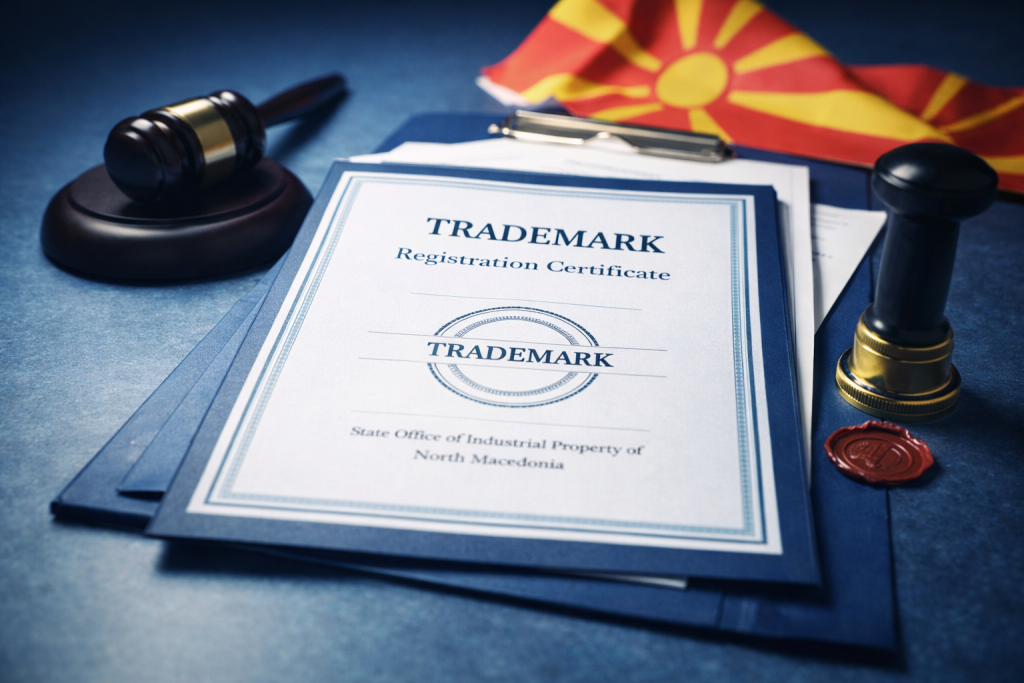
In the broader landscape of intellectual property law in North Macedonia, trademarks occupy a central and highly strategic position. While intellectual property is traditionally divided into copyright and industrial property, trademarks fall within the framework of industrial property rights and require formal registration in order to exist as enforceable exclusive rights. Unlike copyright, which arises automatically upon creation of a work, trademark protection in Macedonia is granted only after a structured administrative procedure before the competent authority.
For businesses operating in North Macedonia, whether domestic companies building strong local brands or foreign investors entering the Macedonian market, registering a trademark in Macedonia is not merely a formal step. It is a long-term investment in brand identity, legal certainty, and commercial stability. A registered trademark provides the exclusive right to use a sign for specific goods and services and the legal tools necessary to prevent unauthorized use by competitors.
Our law office has extensive experience advising clients on trademarks in Macedonia, guiding them through every stage of the procedure—from initial clearance review to registration, opposition proceedings, administrative disputes, appeals, and trademark transfers. We have also coordinated international protection under the Madrid System and represented clients in cross-border trademark negotiations and disputes. We have successfully used the Madrid System to register trademarks originating from North Macedonia in: i) The United States; ii) Canada; iii) The European Union; iv) Australia; v) Singapore; and vi) New Zealand.
Trademarks Within the Framework of Industrial Property
Intellectual property law in North Macedonia distinguishes between copyright and industrial property rights. Copyright protects creative works such as software, databases, literature, music, and design, and arises automatically at the moment of creation. Industrial property, on the other hand, includes rights that must be registered to be protected. These include trademarks, patents, industrial designs, and geographical indications.
A trademark is a sign capable of distinguishing the goods or services of one undertaking from those of another. Its purpose is not merely aesthetic; it serves as a commercial identifier and a guarantee of origin. In practical terms, it protects brand names, logos, slogans, and combinations thereof. Without registration, a company’s ability to enforce its brand rights is significantly weakened.
For this reason, any company seeking to operate securely in the Macedonian market should consider how to register a trademark in Macedonia at an early stage of its business development.
Types of Trademarks in Macedonia
Trademark protection in North Macedonia is not limited to one specific format. Several types of trademarks may be registered, depending on the nature of the sign and the strategy of the applicant.
A verbal trademark consists solely of words, letters, or numbers without any graphical elements. This type of protection is often the strongest because it protects the word itself regardless of font, style, or design. A registered verbal trademark allows the holder to prevent others from using the same or confusingly similar word for identical or similar goods and services.
A figurative trademark, sometimes referred to as a visual trademark, protects logos, stylized elements, or graphic representations. In this case, the protection focuses on the visual identity rather than the wording alone.
A combined trademark includes both verbal and figurative elements. Many companies choose this form because it reflects how the brand appears in the marketplace. However, strategic considerations are important: in some cases, filing both a word mark and a combined mark provides broader and more flexible protection.
Choosing the appropriate type of trademark is a strategic decision that depends on the brand architecture and long-term business goals.
The Procedure of Trademark Protection in North Macedonia
Registering a trademark in Macedonia follows a structured administrative and judicial path. Understanding each phase is essential for building a strong and defensible registration.
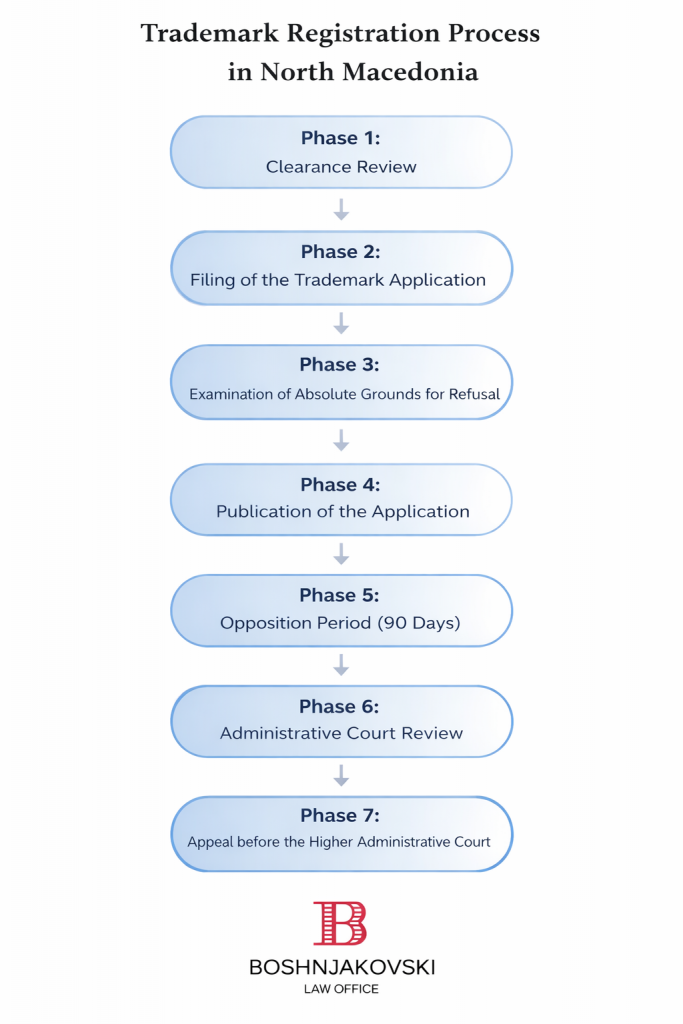
Phase One: Clearance Review and Risk Assessment
Before filing a trademark application in North Macedonia, a thorough review should be conducted to determine whether identical or similar trademarks already exist. This phase is often underestimated, yet it is one of the most important steps in the entire process.
If a competing trademark is identified, several strategies may be considered. Minor modifications to the proposed sign can reduce the likelihood of refusal or opposition. In some cases, it is possible to contact the owner of the earlier mark and negotiate a letter of consent or a coexistence agreement. Such agreements can allow parallel use under defined conditions and prevent costly disputes.
A well-executed clearance strategy significantly reduces the risk of objections and strengthens the overall position of the applicant.
Phase Two: Filing the Application for Trademark Registration
Once the preliminary review is completed, the application for trademark registration in Macedonia is filed before the State Office of Industrial Property. The application must clearly define the sign and specify the goods and services for which protection is sought, in accordance with the Nice Classification.
The filing date is critical, as trademark rights are generally granted according to the principle of priority. The earlier filing date may determine who prevails in the event of competing claims.
Phase Three: Examination of Absolute Grounds for Refusal
After filing, the competent authority conducts an official review of what are known as absolute grounds for refusal. These are criteria examined ex officio, meaning independently of any third-party objection.
A trademark may be refused if it lacks distinctiveness. For example, purely descriptive or generic terms that directly describe the goods or services cannot be monopolized. A sign that simply refers to the nature, quality, quantity, intended purpose, value, or geographical origin of the goods may be rejected.
Additionally, a trademark may be refused if it is contrary to public order or morality. Signs that are offensive to the sensibilities of the nation, discriminatory, or otherwise socially unacceptable are not registrable. Marks that mislead the public as to the nature or origin of goods can also be refused. Furthermore, official emblems, state symbols, and protected insignia cannot be registered without authorization.
If objections are raised during this phase, the applicant may respond with legal arguments or amendments. Proper legal representation at this stage can often overcome initial concerns.
Phase Four: Publication of the Trademark Application
If the application passes the examination of absolute grounds, it is published in the official gazette. Publication is a crucial stage because it opens the door for third parties to challenge the registration.
Phase Five: Opposition Procedure – 90-Day Objection Period
Following publication, holders of earlier trademark rights have a period of ninety days to file an opposition. An opposition typically argues that the applied trademark is identical or confusingly similar to an earlier registered mark and that the goods or services overlap.
Opposition proceedings can involve complex assessments of similarity between signs and between goods and services. The likelihood of confusion is often the central issue.
The State Office of Industrial Property examines the opposition and issues a decision either accepting or rejecting it. Regardless of the outcome, this phase requires careful legal argumentation and, in many cases, strategic negotiation between the parties.
Phase Six: Administrative Dispute Before the Administrative Court
If a party is dissatisfied with the decision rendered in the administrative procedure, the next step is initiating an administrative dispute before the Administrative Court of North Macedonia. This judicial phase reviews the legality of the administrative decision.
Proceedings before the Administrative Court require structured legal submissions and procedural expertise. Trademark disputes at this stage often involve detailed analysis of prior rights, interpretation of statutory provisions, and evaluation of the reasoning provided by the administrative authority.
Phase Seven: Appeal Before the Higher Administrative Court
The final stage in the trademark registration dispute process is an appeal before the Higher Administrative Court. This appellate review examines the correctness of the Administrative Court’s decision.
Having handled cases throughout this entire procedural chain—from filing to appellate litigation—our office offers comprehensive representation in trademark matters in Macedonia.
International Trademark Protection – The Madrid System
Many businesses that register a trademark in Macedonia also seek protection abroad. The Madrid System for the International Registration of Marks allows applicants to extend protection to multiple designated countries through a centralized filing mechanism.
We have assisted clients in coordinating international filings, responding to provisional refusals issued by foreign intellectual property offices, and negotiating solutions with foreign trademark holders. Our experience includes communication with institutions and colleagues in various jurisdictions across Europe and beyond, ensuring that Macedonian brands are effectively protected internationally and that foreign brands entering Macedonia are secured locally.
Trademark Transfers and Assignments in Macedonia
A registered trademark is not merely a legal title; it is a transferable commercial asset. Like any other form of property, a trademark in Macedonia may be assigned, licensed, pledged, contributed as capital, or transferred as part of a broader corporate transaction. In many industries, the trademark itself represents the core value of the business. For that reason, the legal framework governing trademark transfers in Macedonia must be handled with precision and foresight.
Under Macedonian law, a trademark assignment must be concluded in written form. However, signing an agreement between the parties is not sufficient on its own. In order for the transfer to be effective vis-à-vis third parties, the change of ownership must be properly recorded before the State Office of Industrial Property. Until the assignment is registered in the official trademark register, third parties may continue to rely on the previously recorded owner. This is particularly relevant in enforcement proceedings, licensing negotiations, and due diligence reviews.
We regularly advise clients on structuring trademark transfers in Macedonia, ensuring that assignment agreements are clear, legally sound, and aligned with broader commercial objectives. Trademark assignments may involve the transfer of the entire mark for all registered goods and services, or they may be partial, covering only specific classes or certain product lines. Each scenario requires careful drafting to avoid ambiguity and future disputes.
Trademark transfers often arise in the context of mergers and acquisitions, corporate restructurings, spin-offs, joint ventures, and asset purchase agreements. During corporate transactions, intellectual property portfolios are frequently among the most scrutinized assets. Investors and acquirers typically conduct detailed due diligence to verify ownership, validity, and enforceability of trademarks. Any discrepancy between contractual documentation and the official register may raise concerns or delay the transaction. For this reason, ensuring that trademark assignments are properly documented and recorded is not merely a formal step but a critical component of transactional security.
In addition to domestic transfers, trademarks registered in Macedonia may also be assigned internationally. A trademark owner may transfer rights to a foreign individual or company, resulting in a change of ownership that must be reflected both locally and, where applicable, internationally. Where the trademark is part of an international registration under the Madrid System, the change of ownership may need to be recorded with the World Intellectual Property Organization and communicated to the designated countries. Coordinating such cross-border assignments requires familiarity with both Macedonian procedural rules and international registration mechanisms.
We assist clients with international trademark transfers involving multiple jurisdictions, liaising with foreign colleagues where necessary and ensuring that ownership changes are consistently recorded across all relevant registers. Whether the transfer is part of a global corporate restructuring or a standalone asset sale, we ensure that the new owner’s rights are fully secured and enforceable.
Beyond assignments, trademarks may also be licensed rather than transferred. While ownership remains with the original holder, licensing agreements grant defined usage rights to another party. In certain circumstances, licenses may also be recorded in the official register to strengthen legal certainty. Choosing between assignment and licensing is often a strategic decision that depends on long-term business objectives, tax considerations, and risk allocation.
Ultimately, trademark transfers in Macedonia require more than a simple contract. They demand careful alignment between private agreements and public registration. Whether the goal is to transfer ownership domestically, assign rights to a foreign entity, or restructure a multinational trademark portfolio, professional legal guidance ensures that the process is legally sound, commercially efficient, and internationally coherent.
Looking to Register a Trademark in North Macedonia?
If you are planning to register a trademark in North Macedonia, secure brand protection in Macedonia, or transfer ownership of an existing trademark, professional legal guidance is essential. Trademark law in Macedonia is procedural, technical, and highly strategic. A mistake at the filing stage, an overlooked prior mark, or an improperly structured application can result in refusal, opposition, or costly litigation.
As experienced trademark lawyers in North Macedonia, we assist clients with every aspect of trademark registration in Macedonia, including clearance searches, filing applications before the State Office of Industrial Property, responding to objections, handling opposition proceedings, and representing clients before the Administrative Court and Higher Administrative Court. We also advise on trademark transfers in Macedonia, international trademark assignments, and Madrid System filings for clients seeking protection beyond Macedonian borders.
Whether you are a startup launching a new brand, an established company expanding into the Macedonian market, or a foreign investor looking to protect your trademark in Macedonia, we provide comprehensive legal support tailored to your commercial objectives.
📞 Phone: +389 70 257 879
📧 Email: contact@boshnjakovski.com
🌐 Website: www.boshnjakovski.com
Free Consultation
Law is complicated matter. It can cause you a big problem. Let us help you!


The Effect of Chess in Learning
Chessboard could be greater than an game; this activity might be a powerful educational resource what enhances mental abilities and critical thought. Whether someone is a novice for the game or an experienced player, including chessboard inside instruction gives numerous advantages. Begin with essentials, comprehending the way each piece operates & familiarizing oneself to the board. Consistent exercise is essential; participating regularly, even inside regional clubs or online, helps build problem-solving skills also strategic thought. Watching matches via chessboard masters provides understanding regarding complex strategies and choice-making processes. Anticipating opponents’ actions also planning ahead might be important competencies in game of chess. Keeping composed during tension, especially inside contest scenarios, is vital. Game of chess ought to continuously be fun, having each competition providing the possibility towards learn. Involving with the game of chess network, via forums, clubs, or events, may improve the instructional experience, giving help & novel views. Game of chess could be a continuous journey of education & growth. Therefore, incorporate chess inside someone’s learning journey, continue competing, continue studying, and most importantly, enjoy the process.
d46e550