Buying a property in North Macedonia can be an excellent investment — whether you are purchasing an apartment in Skopje, acquiring commercial premises, investing in development land, or planning long-term relocation. The Macedonian real estate market offers competitive prices, strategic geographic positioning, and increasing international interest.
However, property transactions in Macedonia require careful legal analysis. Ownership structures, land classification, third-party rights, zoning rules, and foreign ownership restrictions must all be properly assessed before any agreement is signed.
As experienced real estate lawyers in North Macedonia, we represent domestic and international clients in property acquisitions, real estate due diligence in North Macedonia, dispute resolution, structuring, and regulatory compliance.
Below is a comprehensive legal overview for anyone considering buying property in North Macedonia.
Construction Land vs. Agricultural Land in North Macedonia
One of the most important legal distinctions when buying property in Macedonia is whether the land is classified as construction land or agricultural land.
Construction land is designated for development under applicable urban plans. This includes residential, commercial, industrial, and mixed-use development. If you are buying an apartment in North Macedonia, the underlying land is construction land. Foreign nationals — particularly citizens of EU and OECD member states — may generally acquire ownership of construction land and buildings under the same conditions as Macedonian citizens. For nationals from other countries, acquisition is possible under the principle of reciprocity, which must be confirmed through a formal procedure before the Ministry of Justice.
Agricultural land is subject to significantly stricter rules. Under Macedonian law, foreign individuals and foreign companies are not permitted to directly own agricultural land. This restriction is important for investors considering rural development or long-term land banking strategies.
In practice, there are lawful structuring solutions. One common approach is establishing a Macedonian special purpose vehicle (SPV). Since the company is a Macedonian legal entity, it can hold property in accordance with local regulations. Proper structuring must be done carefully to ensure compliance with land and agricultural legislation.
Types of Objects and Ownership Structures
Macedonian property law distinguishes between land and “objects,” meaning constructed buildings or separate units within buildings.
An object may be:
• A standalone house
• A commercial building
• An industrial facility
• A separate apartment within a residential building
• A business unit within a mixed-use structure
Separate parts of buildings (such as apartments) can be owned individually, while common areas remain jointly owned by all unit holders.
When buying an apartment in Skopje, your lawyer must verify that the unit is properly registered in the Real Estate Cadastre, that the building has valid construction and usage permits, and that no third-party rights exist.
In new developments, it is also essential to confirm that the investor has properly registered ownership of the underlying land and that the project complies with urban planning documentation.
Real Estate Due Diligence in North Macedonia
Real estate due diligence in North Macedonia is not a formality — it is the most critical protective step in the transaction.
Many buyers assume that if a seller appears registered in the Cadastre, the property is safe to purchase. In reality, registration is only the starting point.
When we conduct real estate due diligence in North Macedonia, we perform a structured legal and factual investigation that includes:
- Verification of legal title and acquisition basis
- Review of historical transfers
- Identification of pending disputes or annotations
- Confirmation of encumbrances or enforcement proceedings
- Examination of zoning and urban planning compliance
- Review of building permits and usage approvals
- Assessment of third-party rights
- Evaluation of foreign ownership compliance where applicable
We also verify whether the property is subject to:
- Mortgages registered in favor of banks
- Enforcement proceedings
- Rights of easement (such as access or utility passage rights)
- Usufruct rights
- Long-term lease arrangements
- Expropriation risks
- Environmental or protected area restrictions
Some of these rights survive transfer of ownership. Without proper due diligence, a buyer may unknowingly acquire a property burdened with legal or practical limitations.
Due diligence is especially important for foreign investors buying property in North Macedonia. We verify whether OECD rules apply, whether reciprocity approval is required, and whether structuring solutions are necessary.
We have prepared a detailed general guide on legal due diligence in North Macedonia that explains the methodology and scope in greater depth. We recommend reviewing that article for a broader understanding of how structured legal review protects your investment.
Problems identified before signing can be solved. Problems discovered after registration are often significantly harder — and sometimes impossible — to correct.
Mortgages, Easements and Other Third-Party Rights
Macedonian law recognizes various real rights that may attach to property. These rights are registered in the Real Estate Cadastre and must be carefully examined before purchase.
A mortgage secures a creditor’s claim and allows enforcement against the property if obligations are not fulfilled. Mortgages remain attached to the property even after transfer unless properly discharged.
Rights of easement grant third parties certain usage rights, such as passage across land or installation of utility infrastructure. These may restrict development potential.
Other burdens may include usufruct rights, pre-emption rights, enforcement notices, or court annotations.
When buying property in North Macedonia, failure to review these encumbrances can result in significant financial exposure. A real estate lawyer ensures that any burdens are either removed before closing or properly addressed in contractual protections.
Zoning Rules, Urban Planning and Ecology
Zoning and spatial planning are governed by national legislation and municipal urban plans.
Every parcel of land in Macedonia is subject to a defined planning regime. This determines:
- Permitted use (residential, commercial, industrial, agricultural)
- Maximum building footprint
- Height restrictions
- Infrastructure alignment
- Public access requirements
Before purchasing development land, it is essential to verify whether the intended project is permitted under the current urban plan. Environmental restrictions must also be considered. Properties located near protected areas, water zones, forests, or cultural heritage sites may require additional permits or may face limitations.
Property rights of foreigners in North Macedonia
Foreign ownership rules are often decisive when buying property in North Macedonia.
Citizens of OECD member states may generally acquire ownership of apartments, buildings, and construction land under conditions similar to Macedonian nationals.
Other foreign nationals may acquire property under the principle of reciprocity. Reciprocity must be formally confirmed by the Ministry of Justice, verifying that Macedonian citizens enjoy comparable ownership rights in the buyer’s home country.
Agricultural land cannot be directly owned by foreign individuals or foreign entities. Structuring through a Macedonian company may provide a lawful solution depending on the specific circumstances.
Legal advice at the outset prevents rejected registrations and unnecessary delays.
Property Taxes in North Macedonia: Transfer Tax and Annual Tax
When buying or owning real estate in North Macedonia, it’s important to understand how property taxes work — both the one-off transfer tax at the time of purchase and the recurring annual property tax charged to owners.
When real estate is transferred (for example, sold or otherwise acquired), a property transfer tax applies. This tax is generally based on the market value of the property at the time of transfer and is typically set by the municipality where the property is located. Across most jurisdictions in North Macedonia, the transfer tax rate ranges from approximately 2 % to 4 % of the market value. In practice, the seller is usually the taxpayer, unless the contract specifies that the buyer will pay, or both parties agree otherwise. The precise rate is determined by the municipal council, and exemptions may apply in certain limited situations, such as the first sale of newly built residential properties under specific conditions.
Once you become an owner, you will also be liable for an annual property tax. This tax is levied on the market value of the property as determined by the municipality according to an official valuation methodology. In North Macedonia, annual property tax rates are proportional and generally set between about 0.10 % and 0.20 % of the property’s assessed market value. Municipal councils have the authority to decide exact rates within this range, and in some cases property type (e.g., unused agricultural land) may influence the applicable rate. This annual tax is collected by the local municipality and funds services and infrastructure in your community.
Understanding both the transfer tax and annual property tax is essential for accurate budgeting when buying property in North Macedonia and planning for ongoing ownership costs. Your real estate lawyer can confirm the exact tax rates applicable in your municipality and ensure proper compliance with all local tax obligations.
The General Process of Acquiring Real Estate in North Macedonia
Below is the typical legal pathway for buying property in North Macedonia, assuming the title is clean and no complex third-party rights are involved. While individual transactions may vary, this reflects the standard process followed in straightforward acquisitions.
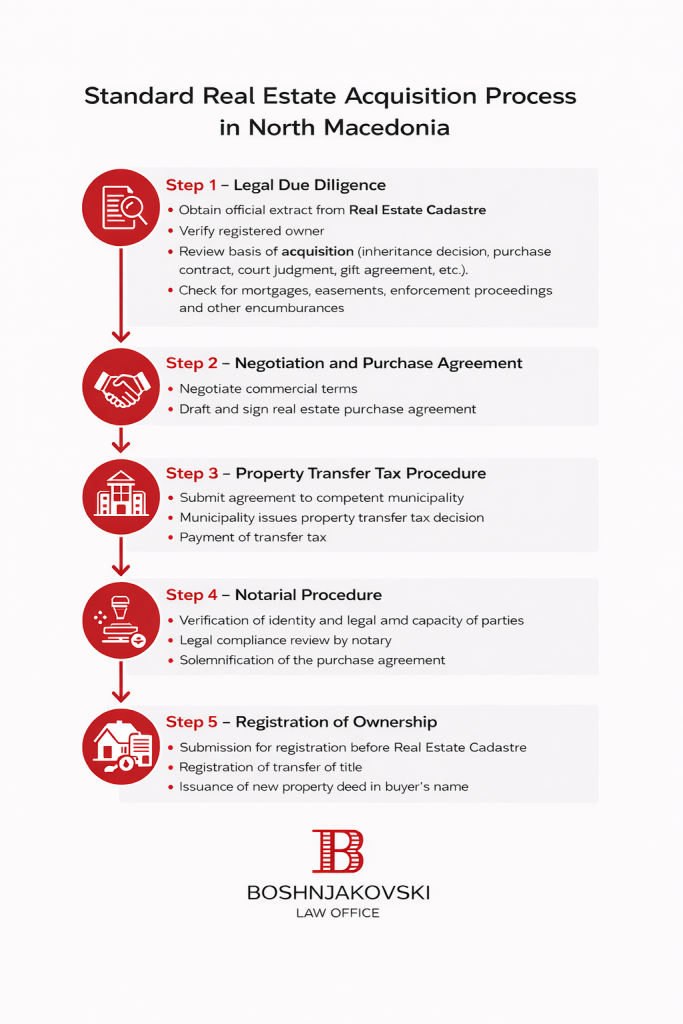
Step 1: Legal Due Diligence
Before signing any agreement, real estate due diligence in North Macedonia must be conducted. This begins with obtaining an official extract from the Real Estate Cadastre to verify the registered owner and identify any mortgages, easements, enforcement annotations, or other encumbrances. However, a cadastre extract alone is not sufficient.
A proper legal review also includes examining the basis on which the current owner acquired the property. This may involve reviewing inheritance decisions, notarized purchase agreements, court judgments, gift agreements, privatization decisions, or other title documents. The purpose is to confirm that the ownership chain is legally valid and uninterrupted. If defects exist in earlier transfers, they may affect the security of the new buyer’s title.
Step 2: Negotiation and Conclusion of the Purchase Agreement
Once the property passes due diligence, the parties negotiate and conclude a real estate purchase agreement. This agreement regulates the purchase price, payment mechanics, possession handover, representations and warranties, liability clauses, and deadlines.
For foreign investors buying property in North Macedonia, the agreement must also address compliance with foreign ownership rules and potential structuring requirements. Proper drafting at this stage significantly reduces post-closing risk.
Step 3: Property Transfer Tax Procedure
After signing the agreement, the transaction moves to the tax phase. The contract is submitted to the competent municipality for assessment of the property transfer tax. The municipality reviews the transaction and issues a formal tax decision determining the amount payable, usually calculated as a percentage of the assessed market value of the property.
The transfer tax must be paid before the transaction can proceed to the next stage. Timely payment is essential to avoid delays in registration.
Step 4: Notarial Solemnification
Following payment of the transfer tax, the agreement is solemnified before a notary public. Notarial solemnification gives the contract the required legal form and enforceability under Macedonian law.
The notary verifies the identity of the parties, confirms their legal capacity, checks the documentation, and ensures that the agreement complies with statutory requirements. Only after solemnification does the contract become suitable for registration in the Cadastre.
Step 5: Registration of Ownership in the Real Estate Cadastre
The final and decisive step is registration of the transfer of title in the Real Estate Cadastre. Ownership is legally transferred only upon registration. Once the Cadastre records the new owner, the buyer obtains full and opposable ownership rights against third parties.
Without registration, ownership is not fully perfected under Macedonian property law.
This structured process reflects a standard, uncomplicated transaction. If a mortgage, enforcement procedure, easement, or other third-party right exists, additional steps may be required, such as creditor consent, discharge of liens, escrow arrangements, or coordinated filings.
Property Investment and Residence Permit
Buying property in North Macedonia may also support immigration objectives.
Under Macedonian immigration law, foreign nationals — particularly from OECD countries — may qualify for a temporary residence permit if they acquire residential property of significant value (commonly above approximately €40,000).
Property ownership alone does not automatically grant residence, but it can serve as a legal basis for a residence application when combined with other statutory requirements.
For investors considering relocation, legal structuring of the acquisition and immigration process should be coordinated from the beginning.
Probate and Inheritance Issues
Real estate in Macedonia is frequently transferred through inheritance. If you are inheriting property in North Macedonia, probate proceedings must be conducted before a notary or competent authority. Ownership registration requires proper documentation and compliance with inheritance law.
Real Estate Disputes in North Macedonia
Disputes may arise from unclear title history, boundary conflicts, contractual breaches, inheritance disagreements, or construction defects.
Our firm regularly represents clients in property litigation and cross-border enforcement matters. For a more detailed discussion of dispute resolution strategies, you may consult our international publications on litigation and enforcement.
Early legal intervention significantly increases the chances of a favorable outcome.
Legal Representation in Real Estate Transactions
As a real estate lawyer in North Macedonia, we represent international investors, diaspora clients, domestic companies, and private individuals in structured, risk-aware property transactions. We combine local regulatory knowledge with international transaction standards to ensure security, compliance, and clarity.
If you are considering a real estate investment in North Macedonia, we would be pleased to guide you through every step of the process.
📞 Phone: +389 70 257 879
📧 Email: contact@boshnjakovski.com
🌐 Website: www.boshnjakovski.com
Free Consultation
Law is complicated matter. It can cause you a big problem. Let us help you!