


Introduction: The Growing Role of an M&A Lawyer in North Macedonia
North Macedonia has evolved into a commercially relevant jurisdiction for regional investors, strategic acquirers, private shareholders, and international groups seeking expansion in Southeast Europe. A flat and competitive corporate tax regime, moderate labor costs, bilateral investment treaties, EU candidate status, and a strategically positioned logistics corridor between Central Europe and the Eastern Mediterranean collectively enhance its attractiveness for transactional activity. That is why getting a mergers and acquisitions lawyer in North Macedonia is essential for your transaction.
Yet, despite its accessibility, the Macedonian legal and institutional environment requires precise structuring. Corporate records are centralized, but historical governance practices may vary in sophistication. Real estate documentation may require verification beyond surface registry extracts. Regulatory compliance depends not only on written law but also on administrative practice. For these reasons, mergers and acquisitions in North Macedonia require more than documentation—they require structural legal oversight.
Engaging an experienced M&A lawyer in Macedonia materially reduces transactional risk. Whether the transaction concerns a share purchase, asset acquisition, market entry strategy, joint venture, minority investment, or distressed acquisition, the structuring phase determines liability exposure, enforceability, tax consequences, and post-closing integration stability.
For foreign investors, regional funds, and international law firms, coordination with a seasoned transactions lawyer in Macedonia ensures that commercial expectations are aligned with local corporate and regulatory realities.
The Role of an M&A Lawyer in Macedonia
The work of a mergers and acquisitions lawyer in North Macedonia begins long before signing and continues well beyond closing. The role is analytical, structural, and risk-oriented.
Transaction Structuring
Every acquisition begins with structural evaluation. A corporate lawyer in Macedonia must determine whether the transaction should be implemented as a share deal, asset deal, merger, spin-off, joint venture, minority investment, or restructuring. The choice affects due diligence scope, tax exposure, employee transfer obligations, regulatory approvals, and post-closing flexibility.
In cross-border M&A Macedonia transactions, structuring must also consider foreign parent company requirements, financing documentation, security packages, and arbitration or dispute resolution clauses.
Legal Due Diligence
Legal due diligence in North Macedonia is entity-wide and risk-focused. It typically covers:
- Corporate governance and shareholder structure
- Registered encumbrances and pledges
- Tax compliance history
- Employment contracts and labor liabilities
- Litigation and enforcement exposure
- Regulatory permits and licenses
- Real estate title and cadastral alignment
- Contractual obligations and change-of-control clauses
As analyzed in detail in the firm’s publication on Legal Due Diligence in North Macedonia, the objective is not merely to review documentation but to translate risk findings into enforceable contractual protections.
In practice, due diligence in Macedonian transactions often uncovers governance gaps, legacy arrangements, or compliance inconsistencies that must be addressed before closing.
Drafting and Negotiation of Transaction Documents
A share purchase agreement in North Macedonia must balance international drafting standards with domestic enforceability. Representations and warranties must be realistically framed. Disclosure mechanisms must be precise. Indemnity provisions must consider local court practice and enforcement timing.
In asset deals, documentation complexity increases significantly. Separate transfer instruments may be required for real estate, movable assets, intellectual property, and contracts.
An M&A lawyer in Macedonia also negotiates escrow arrangements, deferred payments, earn-outs, security mechanisms, and price adjustment clauses.
Regulatory and Competition Considerations
Certain acquisitions trigger competition approval thresholds. Others require sector-specific authority approvals. In regulated sectors—such as energy, financial services, telecommunications, healthcare, and environmental operations—transaction structure must anticipate licensing implications.
A transactions lawyer in Macedonia evaluates these regulatory thresholds early in the process to prevent closing delays.
Closing and Post-Closing Implementation
Share transfers in limited liability companies become effective upon registration before the Central Registry of the Republic of North Macedonia. Corporate resolutions must comply with the Law on Trade Companies. Notarial formalities may apply.
Post-closing work frequently includes:
- Director changes
- Banking mandate updates
- Regulatory notifications
- Corporate governance restructuring
- Integration documentation
The role of a mergers and acquisitions lawyer in Macedonia therefore extends beyond signature to structural stabilization.
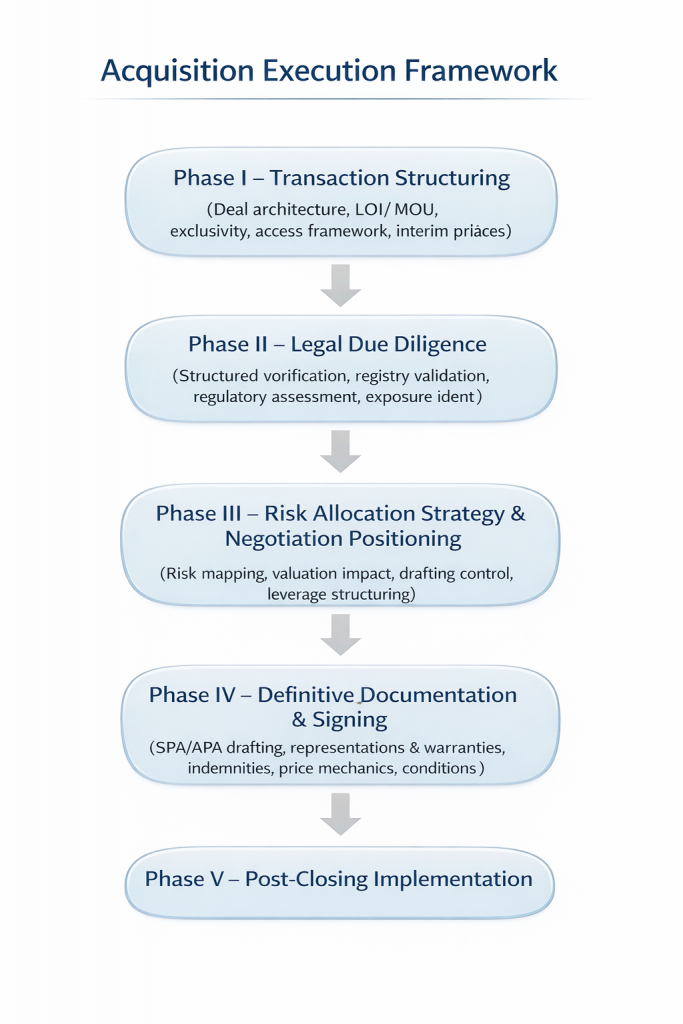
Our Transaction Workflow – Structured, Phased, and Risk-Controlled
A well-designed workflow keeps the transaction moving while maintaining control over legal and regulatory risk. In our practice, we structure acquisitions in clearly defined phases. Each phase has a purpose, a timeline, and a risk-management objective.
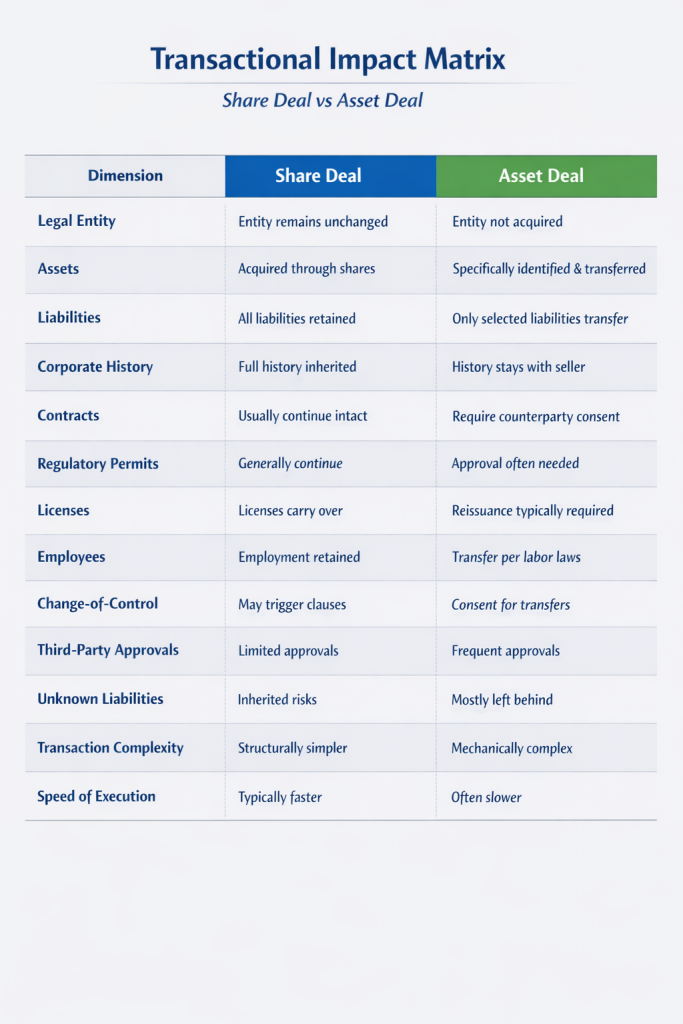
Share deal vs asset deal: how the structure changes the review
Deal structure is a foundational element of any acquisition, as it determines the scope of due diligence, the allocation of risk, and the mechanics of post-closing implementation. In practice, acquisitions in North Macedonia are most commonly structured either as a share deal or as an asset deal, although hybrid and restructuring-based transactions also occur in specific circumstances.
A share deal (share purchase transaction) involves the acquisition of ownership interests in a company. The legal entity remains intact; only the shareholders change. As a consequence, all assets, rights, obligations, and liabilities of the company—known and unknown—remain within the entity after closing. The acquirer steps into the position of the seller as shareholder and indirectly assumes the company’s historical exposure. Due diligence in a share deal is therefore entity-wide. It encompasses corporate governance, historical compliance, tax records, employment relationships, litigation, contractual arrangements, regulatory permits, encumbrances, and contingent liabilities. The principal advantage of a share deal lies in its structural simplicity: contracts, permits, and licenses generally remain with the entity, avoiding the need for individual transfers. It may also preserve regulatory continuity and tax positions. The principal disadvantage is the inheritance of historic risk. Any undiscovered liability remains within the company unless contractually allocated through warranties, indemnities, or price adjustments.
An asset deal (asset purchase transaction), by contrast, involves the acquisition of specific assets and selected liabilities of a business without acquiring the legal entity itself. The buyer identifies and purchases defined assets—such as real estate, equipment, intellectual property, receivables, or contractual rights—while leaving behind unwanted liabilities within the seller’s entity. The principal advantage of an asset deal is risk isolation: historic corporate liabilities typically remain with the seller. However, this structural clarity comes at the cost of greater transactional complexity. Each asset must be individually transferred. Real estate requires cadastre registration; intellectual property assignments may require recordals; contractual rights often require counterparty consent; pledges must be released or restructured; and regulatory permits may require approval or reissuance. In regulated sectors such as energy, construction, or environmental operations, permits may not be automatically transferable, and formal authority approval may be required. Thus, while the legal exposure may be narrower, the execution and documentation burden may be significantly higher.
Cross-Border M&A in Macedonia
Cross-border M&A Macedonia transactions require coordination between domestic and foreign counsel. International investors frequently appoint local M&A lawyers in Macedonia to provide jurisdiction-specific guidance while foreign counsel manages overarching transaction documentation.
Recognition of foreign corporate documentation may require apostille or legalization. Corporate approvals adopted abroad must align with Macedonian registration standards.
Arbitration clauses and governing law provisions must consider enforceability within Macedonian courts. Security instruments must comply with domestic pledge registration systems.
A transactions lawyer in Macedonia bridges legal systems and mitigates jurisdictional friction.
Industry-Specific Transactions
Mergers and acquisitions in Macedonia span diverse sectors.
Technology and software companies attract foreign investors seeking cost-efficient engineering talent. Healthcare laboratories and private clinics have experienced consolidation. Manufacturing businesses, particularly export-oriented entities, are common acquisition targets. Real estate holding companies require enhanced title verification. Family-owned enterprises often involve succession planning considerations.
Small and medium-sized enterprise acquisitions represent a significant share of transactional activity. Market entry acquisitions allow foreign investors to accelerate operational launch through existing legal entities.
A corporate lawyer in Macedonia tailors due diligence and contractual drafting to sector-specific risk.
Key Risk Areas in Macedonian Transactions
Recurring risk areas include:
- Informal corporate governance
- Undocumented shareholder understandings
- Hidden tax exposure
- Employment contribution inconsistencies
- Cadastral discrepancies
- Regulatory permit transferability
- Pending litigation exposure
Effective mergers and acquisitions lawyers in Macedonia identify these issues early and translate them into enforceable protections.
Why Local M&A Counsel in Macedonia Is Essential
Knowledge of institutional practice is critical. Administrative interpretation often shapes transaction feasibility. Court enforcement culture influences indemnity drafting. Notarial practice affects timing.
A local Mergers and Acquisitions Lawyer in North Macedonia ensures alignment between documentation and practical implementation. Negotiation culture in Macedonia blends formal legal argument with relational sensitivity. Experienced counsel navigates both.
An experienced M&A lawyer in Macedonia provides strategic oversight, risk mitigation, and transactional stability for domestic and international investors.
For advisory services relating to mergers and acquisitions in Macedonia, cross-border M&A, share purchase agreements, asset deals, and corporate structuring:
📞 +389 70 257 879
📧 contact@boshnjakovski.com
🌐 www.boshnjakovski.com
Бесплатна консултација
Правото е сложена материја. Може да ви предизвика голем проблем. Дозволете ни да ви помогнеме!
